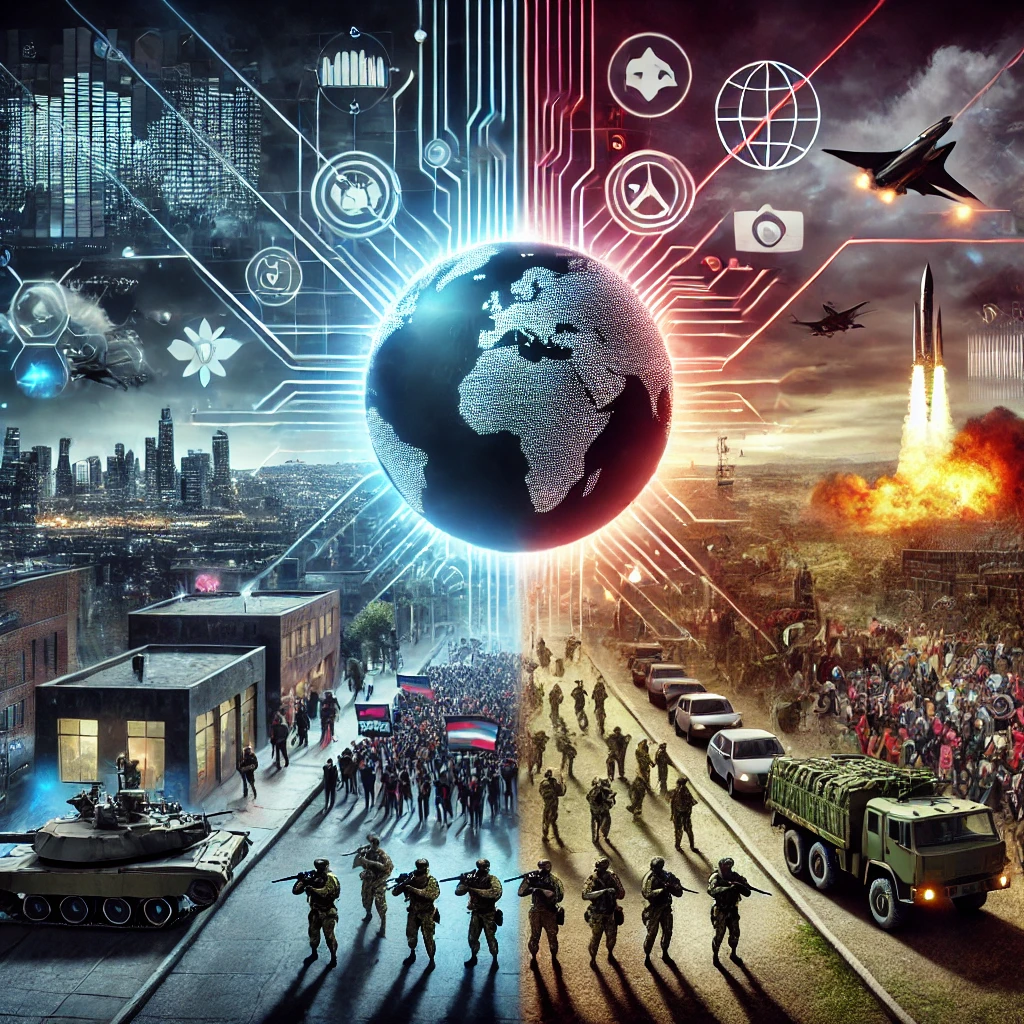
Hybrid Warfare: The Modern Conflict Model of the 21st Century
Conflicts have played a structural role in the
development of human society and throughout history have served as one of the
main driving forces behind political, economic, and social transformations. In
earlier periods, confrontations were primarily explained by such fundamental
factors as the distribution of resources, territorial control, and social
inequality. Despite technological and political changes, these factors remain
relevant today. Over time, not only the causes of conflicts have changed, but
also the mechanisms through which they are conducted, the tools employed, and
the structure of the actors involved. Each era has produced its own model of
warfare, and over time these models have become increasingly complex,
multidimensional, and asymmetric.
One of the most widely discussed concepts in
the modern security environment is hybrid warfare, although the boundaries and
scope of this concept are not universally agreed upon within academia. While
its “newness” is often emphasized, many of its individual elements have existed
throughout history. The difference today is that these elements are
systematically and coordinately combined through advanced technological means.
In particular, digital communication and cyber operations have expanded the
reach of this strategy, creating opportunities for rapid and large-scale
influence within the information environment.
Whereas traditional warfare was characterized
by open armed confrontation, the hybrid approach seeks to avoid direct military
conflict whenever possible, weaken the opponent from within, and minimize
international reaction. Alongside military means, states employ information
manipulation, cyberattacks, economic pressure, and proxy forces in order to
implement multidimensional strategies of influence. As a result, the classical
boundary between “war” and “peace” effectively disappears, and conflict turns
into a complex process encompassing all spheres of society, including the
economy, culture, the information space, and domestic politics.
During the twentieth century, particularly
throughout the Cold War, confrontations were largely shaped within an
ideological framework. However, cases such as Vietnam and Afghanistan
demonstrate that non-state actors and proxy forces already played a significant
role during that period. In the contemporary era, however, the dynamics have
changed. Non-state actors united around ethnic, religious, and local interests
are assuming an increasingly important role. Globalization and technological
development have expanded the geographical scope of their activities and
enabled them to exert influence on a global scale.
These changes place significant pressure on the
Westphalian principle of sovereignty, which forms the foundation of the
international system. According to the classical Westphalian model, states are
considered to possess supreme sovereignty over their territories. Hybrid
warfare undermines this control through indirect means, blurring the boundary
between internal and external intervention. Consequently, states are compelled
to fundamentally reconsider their security concepts.
One of the defining characteristics of hybrid
warfare is the high degree of ambiguity and the principle of plausible
deniability. The attacking side is often not directly identifiable, which
delays or weakens international legal responses. For this reason, the hybrid
approach is not merely a military strategy, but also a powerful political and
psychological mechanism of influence. This situation significantly complicates
the implementation of international legal norms.
Hybrid warfare combines various domains:
conventional military operations, irregular warfare, information and cyber
warfare, economic sanctions, energy manipulation, and psychological operations.
The synchronized application of these components creates a multidimensional and
dynamic conflict environment in which classical defense mechanisms often prove
insufficient.
Historical parallels demonstrate that the use
of mercenary forces and indirect instruments of influence such as
disinformation could already be observed in medieval European wars. In the
modern era, however, these elements have acquired a far more systematic
character due to technological advancements.
The events in Crimea in 2014 are frequently
cited as an example of hybrid warfare. In this case, the use of unofficial
military forces, intensive information campaigns, and the mobilization of local
actors played an important role, although the international assessment of these
processes remains controversial.
Nevertheless, the concept of hybrid warfare is
not universally accepted. Frank Hoffman defines hybrid warfare as the
integration of conventional and unconventional means, whereas Mark Galeotti
argues that the concept has been analytically overstretched. In his 2013
speech, Valery Gerasimov emphasized the growing role of non-military means in
modern conflicts; however, it is widely acknowledged that the approach known in
the West as the “Gerasimov Doctrine” was not formally presented by him as an
official strategy.
Another important characteristic of hybrid
warfare is its long-term and phased nature. Rather than seeking immediate
victory, it is based on a strategy of gradually weakening the opponent,
deepening internal contradictions, and step-by-step gaining strategic
positions.
Ultimately, hybrid warfare has become one of
the most widely used concepts for explaining modern conflicts. It relies not
only on physical force, but also on the comprehensive exploitation of an
opponent’s vulnerabilities. This reality compels states to move beyond
classical military doctrines and develop integrated security strategies capable
of responding to multidimensional, flexible, and asymmetric threats. At the
same time, this model creates new and serious risks for international stability
and indicates that future conflicts are likely to become even more complex and
difficult to predict.